On this page 6 sections
Bitcoin Basics Buying, Mining, and Everyday Applications
Here is what you need to know about Bitcoin Explained. Bitcoin is a decentralized digital currency that operates without a central authority or banks. It allows peer-to-peer transactions on a network called blockchain, which is a public ledger that records all Bitcoin transactions.
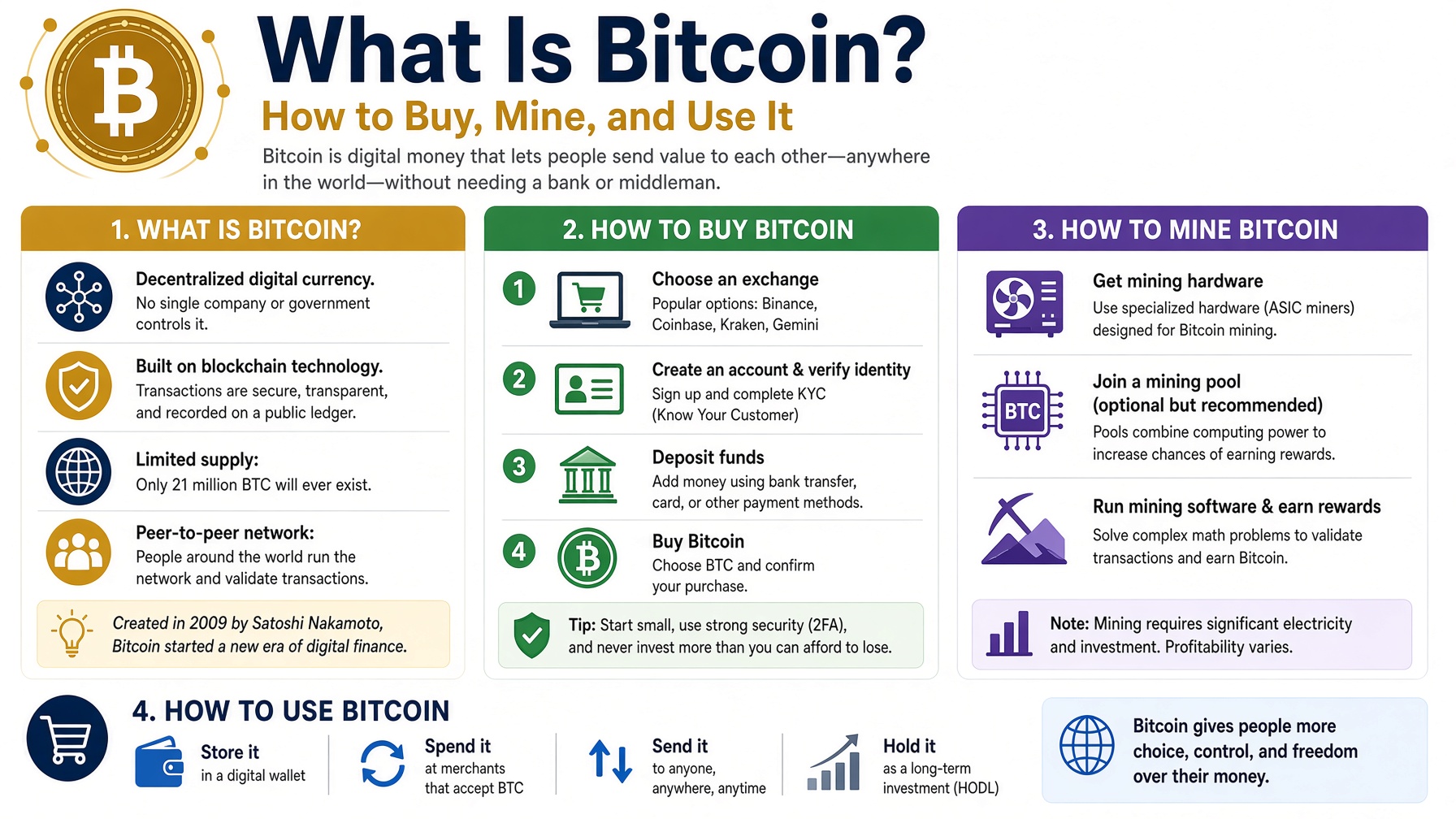
What Is Bitcoin?
- Digital Currency: Bitcoin exists only online and is secured by cryptography.
- Decentralized: No government or bank controls Bitcoin.
- Limited Supply: Only 21 million Bitcoins will ever exist.
- Blockchain Technology: Transactions are verified and recorded on a transparent, secure ledger.
How to Buy Bitcoin
- Choose a Bitcoin Wallet: A digital wallet stores your Bitcoins. Options include software wallets (apps), hardware wallets (physical devices), or online wallets.
- Select a Cryptocurrency Exchange: Platforms like Coinbase, Binance, or Kraken let you buy Bitcoin using regular money.
- Create and Verify Your Account: Sign up and complete identity verification.
- Deposit Funds: Add money via bank transfer, credit card, or other methods.
- Buy Bitcoin: Place a buy order for the amount of Bitcoin you want.
- Transfer to Wallet: For better security, transfer your Bitcoin from the exchange to your private wallet.
How to Mine Bitcoin
- Mining is the process of validating Bitcoin transactions and adding them to the blockchain.
- Miners use powerful computers to solve complex mathematical problems.
- Successful miners earn new Bitcoins as a reward.
Note: Mining requires expensive hardware, electricity, and technical knowledge, so it’s less common for beginners.
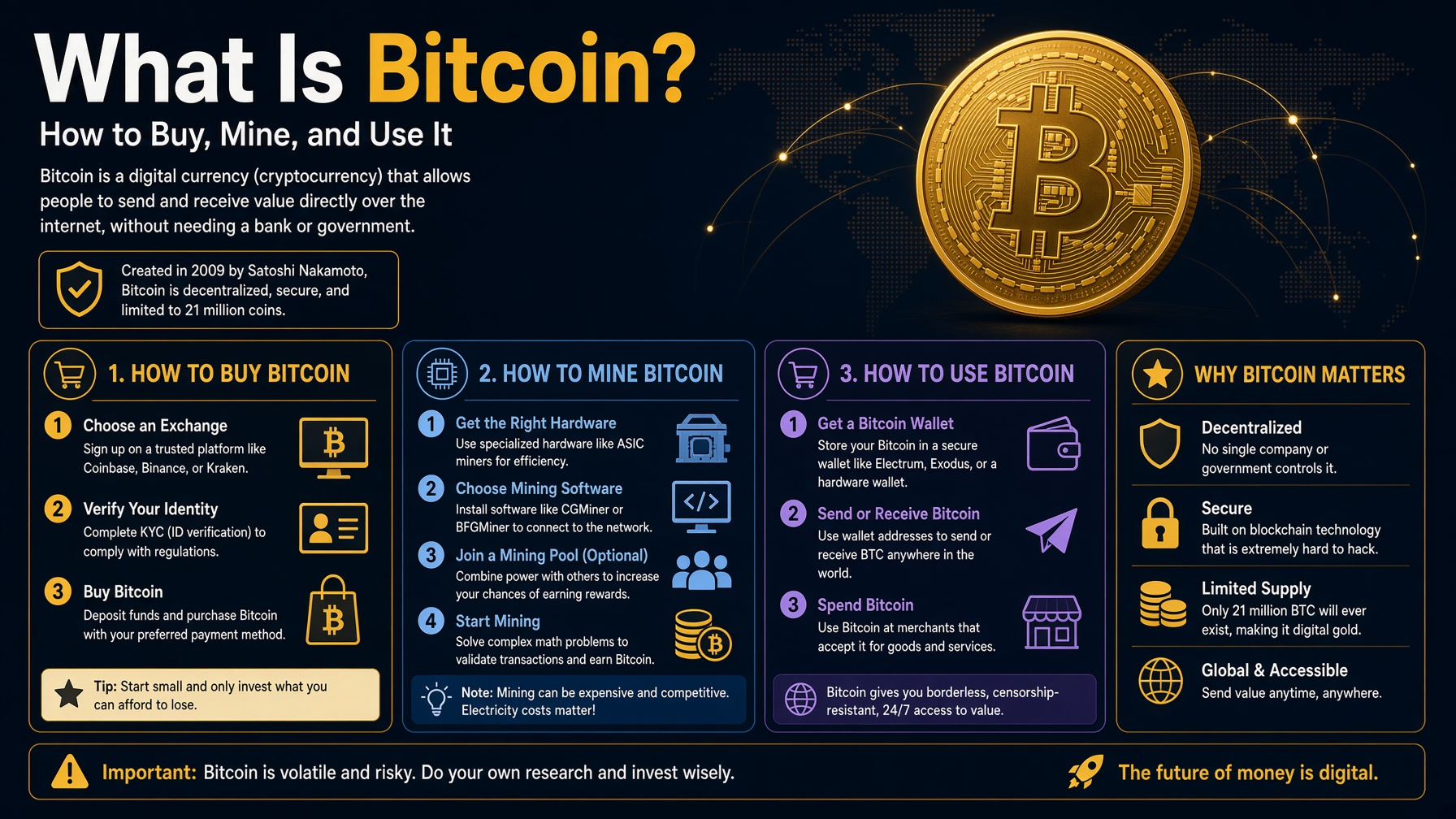
How to Use Bitcoin
- Make Transactions: Send Bitcoin to others for goods, services, or as payment.
- Online Shopping: Many online retailers accept Bitcoin.
- Investment: Hold Bitcoin as a long-term asset.
- Remittances: Transfer money internationally with lower fees.
- Decentralized Finance (DeFi): Participate in blockchain-based financial services.
Summary
Bitcoin is a revolutionary digital currency enabling secure, decentralized transactions. You can buy it on exchanges, mine it with specialized hardware, and use it for payments, investments, and more.
Choosing Where to Buy
The exchange you use decides what you pay and how well your money is protected. Three checks cover most of it.
- Is it allowed to serve your country? Licensed exchanges publish the company and regulator for each region. Since July 2026, exchanges need authorisation under the EU's MiCA rules to serve European customers.
- What does a purchase really cost? The instant-buy button in most apps adds a spread or a higher fee. The order book on the same exchange is usually much cheaper.
- What is its security record? Look at whether it has been hacked and how it treated customers afterwards.
Our crypto exchange ranking compares 60 platforms on fees, licences and security incidents, with a review of each.
Hot Wallets and Cold Wallets
A wallet does not hold coins. It holds the private keys that control them.
- Exchange account: the exchange holds the keys. Convenient, but you depend on the company staying solvent and secure.
- Software wallet: an app on your phone or computer. You hold the keys; the device is connected to the internet.
- Hardware wallet: a small device that keeps keys offline. The safest choice for savings.
Whichever you choose, the recovery phrase, usually 12 or 24 words, is the real key. Write it on paper, store it somewhere safe and never type it into a website or send it to anyone. Nobody from a genuine company will ask for it.
Why the Supply Is Limited
New bitcoins are issued to miners as a reward for each block. That reward is cut in half about every four years, in an event known as the halving. The most recent was in April 2024, when the reward fell to 3.125 bitcoins per block. Because of the halving schedule the total can never exceed 21 million.
Fees and Confirmation Times
Sending bitcoin costs a network fee paid to miners. The fee depends on how busy the network is, not on the amount sent. A block is added about every ten minutes, and many services wait for several confirmations before treating a payment as final. For small, frequent payments some people use the Lightning Network, which settles almost instantly.
Risks to Understand First – Bitcoin Explained
- Price swings. Bitcoin can lose a large share of its value in weeks.
- No reversals. A payment sent to the wrong address cannot be recalled.
- Scams. Guaranteed returns, fake support staff and "recovery" services are the common ones.
- Tax. Many countries tax gains on crypto. Keep a record of every purchase and sale.
A sensible start is a small amount, bought on a licensed exchange and moved to your own wallet once you have practised with a test transfer. This article is educational and is not financial advice. We keep this bitcoin explained guide updated as the terms change. Always check the latest bitcoin explained terms on the official website before you sign up. Bookmark this bitcoin explained page so you can compare offers later.
Further reading: Investopedia: What is forex?